
It’s midnight and you finally finished studying for your math test. You are tired but you still need to shower and finish your history homework, realizing you won’t be able to go to sleep until at least 1:15 am. You set your alarm for 7:15 am, just six hours later. By the time morning comes, you are already exhausted, and you are not alone.
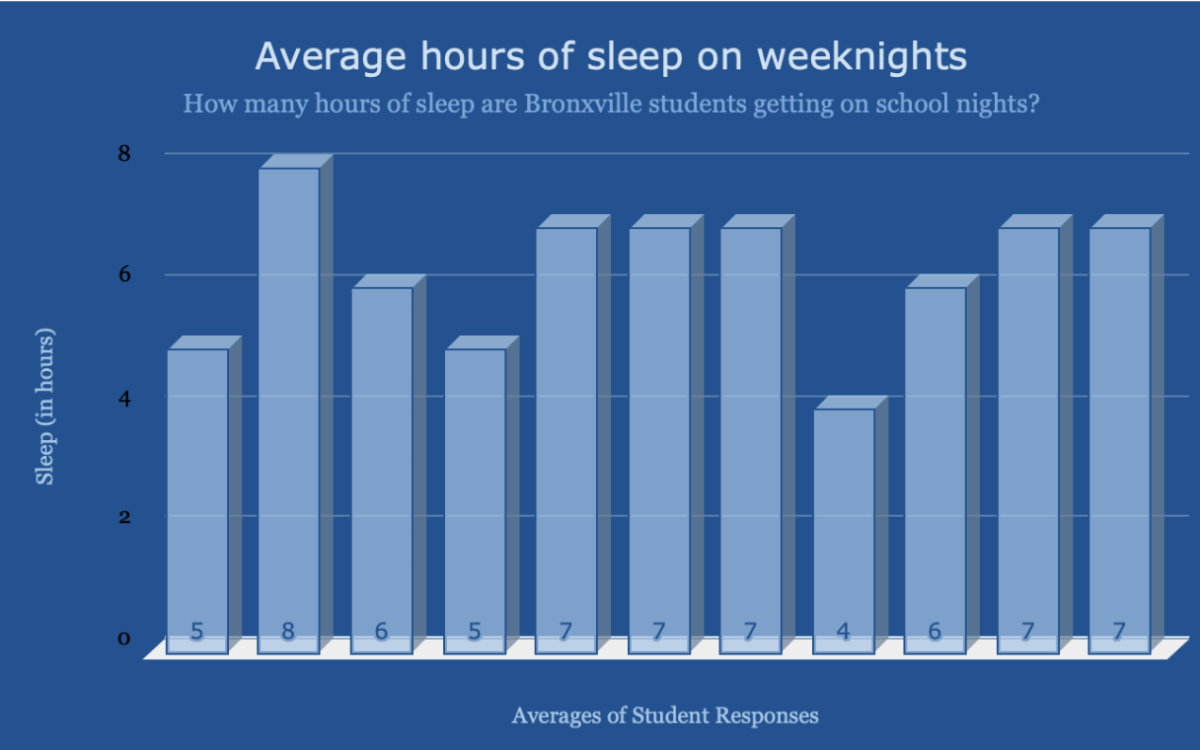
Sleep deprivation feels like a normal part of high school life. While teenagers are recommended to get around 8–10 hours of sleep per night, many students are falling short. Based on survey responses collected from students across the high school, a clear pattern can be seen; most students are not getting enough rest and it impacts them every day.
Slightly over 45% of students report getting only 7 hours of sleep on school nights, while 9% admitted they only get 4 hours or less. Despite this, 0% of students said they consistently feel well-rested in the morning. We may think being tired is normal, but the truth is, students are not getting enough sleep. Most students (54%) wake up between 6:15 and 7:15 a.m., meaning late nights are frequently early mornings for the students of Bronxville.
According to the data, the biggest factor keeping students awake is academic workload, with every student identifying homework and studying as a primary reason for staying up late. In addition, over half of students reported that stress and phone use also play a significant role in delaying sleep. Extracurriculars are also contributing, creating packed schedules that leave little time to unwind for students.
The effects of this lack of sleep are hard to ignore. Students consistently reported feeling tired during the school day, and nearly all agreed that sleep directly impacts their performance. As one student wrote, “It impacts the way I perform in school, and especially influences my focus.” Another explained, “Sleep affects my ability to do well in school and in sports.”
Even students who reported getting closer to seven hours of sleep still described feeling like they had consistent low energy and unfocused. One student shared, “If I don’t get enough sleep I normally am not as energetic… and don’t want to do any work.” Another added that “sleep impacts the way I perform in school, especially my focus.”
Interestingly, many responses mentioned lack of focus as a consequence of not getting enough sleep or being tired. This connection is supported by research in neuroscience, which shows that sleep deprivation weakens attention, memory, and decision-making. For example, studies have found that even moderate sleep loss, 1-3 hours of less sleep, can make it harder for students to concentrate in class, process new information, and stay engaged throughout the day. In other words, the exhaustion students describe isn’t just a feeling, it has measurable effects on how well they are able to learn and perform academically.
Together, these responses suggest that sleep deprivation isn’t just occasional, it’s part of the daily routine for most students. While some admit that social life or personal habits play a role, the overall trend points to a larger issue; students are balancing heavy workloads, high expectations, and constant distractions, often at the cost of their health.
These findings raise an important question: if so many students are consistently running on too little sleep, what can actually be done about it?
Unfortunately, there is no simple solution. Students can try to limit phone use at night or manage their time more efficiently, but those changes can only do so much when students are opting to take rigorous courses or participating in time consuming extracurriculars. When homework, stress, and packed schedules are the main causes, the issue becomes bigger than just individual habits, and many students are, understandably, unable or unwilling to sacrifice their extracurriculars, academic performance or relationships.
Sleep is often the first thing students sacrifice, but it may also be one of the most important for their ability to function. Until it’s treated that way, many students will continue to start each day already running on empty.